
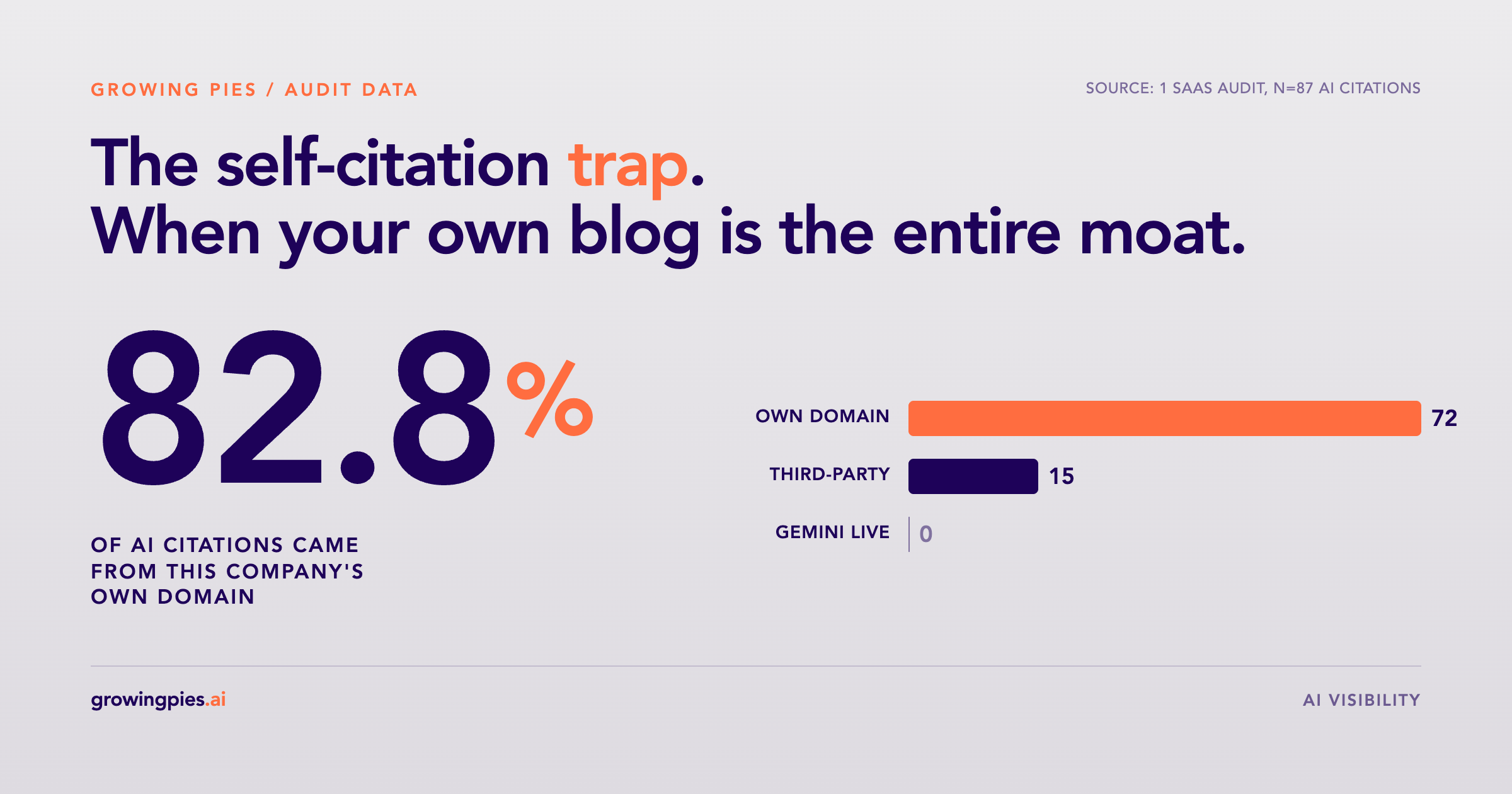
If most of your AI mentions come from your own website, you don't have a moat. You have a single point of failure.
We see this constantly. A company runs a content operation for two or three years, ranks decently on Google, gets pulled into Google AI Overviews from their own blog — and then assumes they've cracked AI visibility. They haven't. They've built a self-referential loop that one algorithm change can erase overnight.
Here's the audit data that made us name the pattern.
The numbers from one real audit
SaaS startup, design tool category. Decent traction. We pulled their full AI citation footprint across Google AI Overviews, ChatGPT, Gemini, and Perplexity. 87 total mentions.
| Source | Mentions | % of Total |
|---|---|---|
| Their own domain (blog + docs) | 72 | 82.8% |
| Third-party publications | 15 | 17.2% |
| Total | 87 | 100% |
Then the platform breakdown:
| Platform | Mentions | Where they came from |
|---|---|---|
| Google AI Overviews | 66 | Mostly their own blog |
| ChatGPT | 21 | Mix, mostly own content |
| Gemini (live queries) | 0 | — |
| Perplexity | Not indexed | — |
Read it again. Gemini — the platform Google is putting billions of dollars behind — returns zero mentions on live queries. The whole AI footprint is a Google AI Overviews echo chamber pulling from their own subdomain.
Why this is fragile, not strong
If you'd shown me 87 AI mentions five years ago I'd have called it a healthy number. The problem is mechanical: AI systems weight their own domain citations very differently from third-party citations, and when an update changes the weighting, your "moat" disappears.
Three things make self-citation dependency dangerous:
- Algorithm risk. Google AI Overviews has changed its citation behavior at least three times in the last 18 months. Each change reshuffles which sources get pulled. If your only path into the answer is your own blog, every update is a coin flip.
- Platform concentration. Self-citation tends to cluster in one platform (usually Google AI Overviews, because Google has the easiest path back to your own indexed content). The other platforms — ChatGPT, Gemini, Perplexity — weight third-party signals more aggressively, which is why this company has zero presence on Gemini.
- Recommendation gap. Self-cited content is almost always informational — tutorials, FAQs, education posts. That's the content your blog produces. None of it is "and you should buy from this vendor." So even when AI cites you, it cites you for the wrong context.
What the competitor did differently
Here's the part that should annoy you. One of this company's direct competitors published a single article called "Meet Your New Product Agent." Just one. Gemini cited it almost immediately and started recommending the competitor in product-aware design queries.
Our client has been publishing two posts a week since 2023. Volume isn't the variable. Placement is.
The competitor's article wasn't on their own domain. It was placed in a publication AI happens to trust. That single decision — where the content lived, not how good it was — made the difference.
How much of your AI visibility is self-cited?
Get the breakdown across ChatGPT, Gemini, and Google AI Overviews. We split self-citations from third-party signals so you know what's actually durable.
GET YOUR AI VISIBILITY ANALYSISHow to actually fix this
Diversifying away from self-citation isn't complicated — it's just unglamorous. Three moves, in priority order:
- Find the publications AI already trusts in your category. Run the prompts your buyers run, list every domain that gets cited, count the frequency. Those are your placement targets. For most B2B SaaS categories, the list is shorter than you'd guess — usually 15 to 25 domains.
- Get on those lists in the lowest-cost way possible. Roundup pitches. Contributed articles. Expert quotes. Comparison page outreach. None of this is novel; it's basic digital PR. The novel part is targeting based on AI citation data instead of guessing.
- Build one defensible artifact per quarter that other people will cite. Original data, a benchmark, a category map. Something a writer at Healthline or G2 or Reddit can reference. If you don't have anything cite-worthy, you're stuck waiting for AI to discover your own blog — and we just covered why that's a fragile bet.
None of this replaces your own content. Your blog still has to exist. But the assumption that publishing more on your own domain will fix AI visibility is wrong, and it's the most common mistake we see in our audits.
If 80%+ of your AI citations are coming from your own URL, you're not winning. You're surviving. There's a difference.