
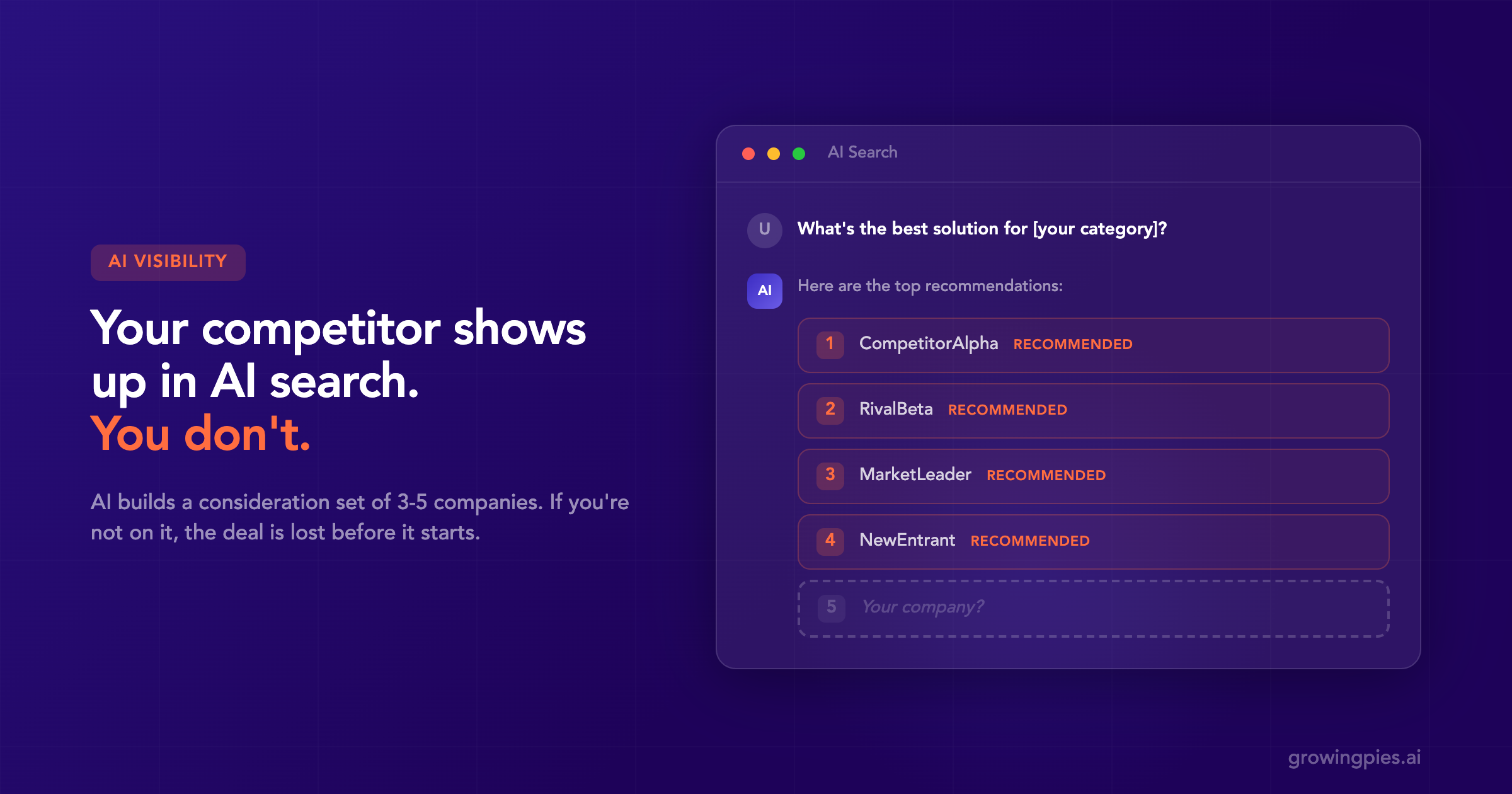
When your buyer asks ChatGPT a category question — not your brand name, the actual problem you solve — the model returns a shortlist of 3 to 5 companies. That shortlist is the new consideration set. Make it, and you have a shot. Miss it while your competitor makes it, and the deal was over before anyone picked up a phone.
Every AI visibility audit we run includes the same exercise: same prompts for the prospect, same prompts for their closest competitors, side by side. The gaps aren't subtle. Most of the time they're embarrassing.
The shortlist you're not on
A SaaS design tool startup hired us to figure out their AI presence. Their product is genuinely differentiated — a "product-aware AI design agent" that pulls your existing product context before generating UX. No direct competitor does exactly this.
We ran five prompts on Gemini asking variations of "what's the best AI tool for product designers?" Eight tools came back across those five prompts. This company appeared zero times.
| Tool Named by Gemini | Appearances (out of 5 prompts) |
|---|---|
| Figma Make | 4 |
| Galileo AI | 4 |
| A newer, less-funded competitor | 3 |
| Uizard | 3 |
| Framer AI | 3 |
| This company | 0 |
Look at the third row. Newer than this company. Less funded. Less differentiated. And it landed in 3 out of 5 prompts — because it got featured in exactly one roundup article on a design blog that AI happens to trust. That single placement is the entire reason it's on the shortlist and our client isn't.
Two direct competitors are running 2-3x the total AI mentions:
| Company | Total AI Mentions | Impressions |
|---|---|---|
| Competitor A (Uizard) | 214 | 13.6M |
| Competitor B (UXPilot) | 198 | 10.8M |
| This company | 87 | 2.0M |
Dead last in their own competitive set. And it has nothing to do with product quality. It has everything to do with what AI can see.
How do you compare to your competitors in AI search?
Our AI Visibility Analysis tests your brand and your top competitors across ChatGPT, Gemini, and Google AI. Takes 2 minutes to order.
GET YOUR AI VISIBILITY ANALYSISYour branded query is sending customers to your rival
It gets worse. The competitive damage isn't limited to category discovery. It happens on your own branded queries.
Luxury resort chain. 30+ properties. 280 AI mentions. Their main competitor has 4 properties. We tested five high-intent category keywords — "luxury all-inclusive resorts Mexico," "best resorts Riviera Maya," "best honeymoon resorts Mexico," "family-friendly luxury resorts Mexico," "luxury resorts Nuevo Vallarta." Here's how it shook out:
| Category Keyword | This Company | Primary Competitor |
|---|---|---|
| Luxury all-inclusive resorts Mexico | Absent | Present |
| Best resorts Riviera Maya | Absent | Present |
| Best honeymoon resorts Mexico | Absent | Present |
| Family-friendly luxury resorts Mexico | Absent | Present |
| Luxury resorts Nuevo Vallarta | Present (#4) | Present |
Competitor: 5 out of 5. Our client: 1 out of 5. 7.5x the property count, 1/5th the visibility on the queries that matter.
Then we found the part that actually made the call awkward. When a customer asked ChatGPT about one of this company's own sub-brands — "Is [sub-brand] all-inclusive?" — ChatGPT said "no" and, in the same response, recommended the competitor by name.
This is somebody who already knew the brand. Already interested. Warm lead. AI sent them somewhere else. Not because the competitor paid for the spot — nobody pays for AI placement — but because the competitor had clean, crawlable content about all-inclusive resorts, and our client's FAQ loaded via JavaScript that AI crawlers can't read. A six-figure deal lost to a rendering decision a developer made years ago.
Somebody else is claiming your positioning
This is the worst pattern we've found. A company's unique value prop being described by AI in detail — and credited to a competitor.
The SaaS design startup coined the term "product-aware AI design agent." It's their entire wedge. When AI explains this concept to a buyer, it doesn't mention them. A newer competitor gets the credit.
| Concept | Who Built It | Who AI Associates It With |
|---|---|---|
| “Product-aware AI design agent” | This company | Neither (unclaimed) |
| Context-aware design generation | This company’s core product | The newer competitor (via 2026 reviews) |
This isn't theft. It's a vacuum. The newer competitor got written about in third-party reviews and roundup articles. Our client didn't. AI learned the concept from the coverage and attributed it to whoever showed up in the coverage. There's no malice in the model — it just credited the loudest source.
The concept is still technically unclaimed. All 5 product-specific keywords show 0 AI search volume right now — the category is being born. Whoever defines it owns it. But that window doesn't stay open forever, and once AI hardens an association, you spend years trying to unwind it.
The self-citation trap
One of the scariest things we keep finding: companies whose AI visibility is almost entirely sourced from their own domain.
That same SaaS startup had 82.8% of its AI citations coming from its own website. 66 of its 87 mentions are Google AI Overviews pulling from its blog. 21 from ChatGPT. Gemini — which Google is investing billions into — returns zero mentions on live queries.
| Platform | Mentions |
|---|---|
| Google AI Overviews | 66 |
| ChatGPT | 21 |
| Gemini (live queries) | 0 |
When the vast majority of your AI citations come from your own site, you're one algorithm update away from zero. Third-party citations — YouTube, Reddit, G2, Wikipedia, editorial roundups — are what make AI visibility durable. Our client has almost none of those.
Their competitor? Published one article — "Meet Your New Product Agent" — and Gemini cited it. Our client has been publishing blog content since 2023 and has zero product-recommendation citations on any platform.
Volume of content doesn't drive AI visibility. Placement does. This is the part that's hard to internalize, because it inverts everything we were told about content marketing.
The platform gap problem
Local healthcare provider. 34 AI citations — 20 on Google AI Overviews, 14 on ChatGPT. That sounds balanced until you look up. YouTube has 6,819 mentions in their category. Healthline has 3,456. Our client lands at positions 4-9 while those two own positions 1-3 almost permanently.
In a category that does 228,690 monthly AI searches, the gap between position 2 and position 7 is the gap between getting recommended and getting buried.
Why competitors win AI (and it's not what you think)
The companies dominating our audits share three traits. None of them involve product quality or marketing budget:
- Third-party validation. AI weights mentions from editorial publications, review sites, and community discussions much more heavily than anything on your own domain. G2 alone generates 112 AI citations on a single keyword in the design tool category. That's more than most of our prospects have on their entire site.
- Clean positioning. The luxury resort competitor wins because every property is Five Diamond. AI can recommend them without caveats. The company with 30+ properties spread across multiple tiers gives AI too many qualifiers to add — and AI prefers the clean answer.
- Crawlable content. If your site loads key pages via JavaScript, crawlers don't see them. The resort chain lost branded queries to a competitor because their FAQ was dynamically rendered. Yes, this is 2026 and we're still talking about JavaScript rendering. It's still costing real money.
The compounding effect
The reason every month makes this worse: AI visibility compounds. Companies that get cited today get cited more tomorrow. Each citation creates conditions for more citations. Each absence makes future absence more likely.
Run the math on our SaaS startup. They're at 87 mentions and 2 million impressions. If they hit competitor parity at 198 mentions, impressions don't double — they jump to 10.8 million. A 5.4x multiplier on a 2.3x mention increase. Higher-intent product-recommendation queries carry disproportionately more impressions than informational ones, so the curve isn't linear, it's exponential.
And every month they wait, the gap is wider.
Find out where you stand
Most companies have never tested what AI says about them next to their competitors. They're flying blind in a channel that's growing 41x year-over-year in some categories. That's not sustainable.
Our $99 AI Visibility Analysis runs your brand and your top competitors through ChatGPT, Gemini, and Google AI Overviews. We show you:
- Who AI recommends instead of you, and why
- Which competitive gaps you can actually close in 90 days
- Whether your AI mentions are real recommendations or informational noise
- Platform-by-platform visibility next to your direct competitors
- The specific content and technical gaps driving the disadvantage
Every number comes from real API data. No estimates. No guesses. If we don't have the data, we say so.