
One number from a recent audit has been stuck in my head for weeks.
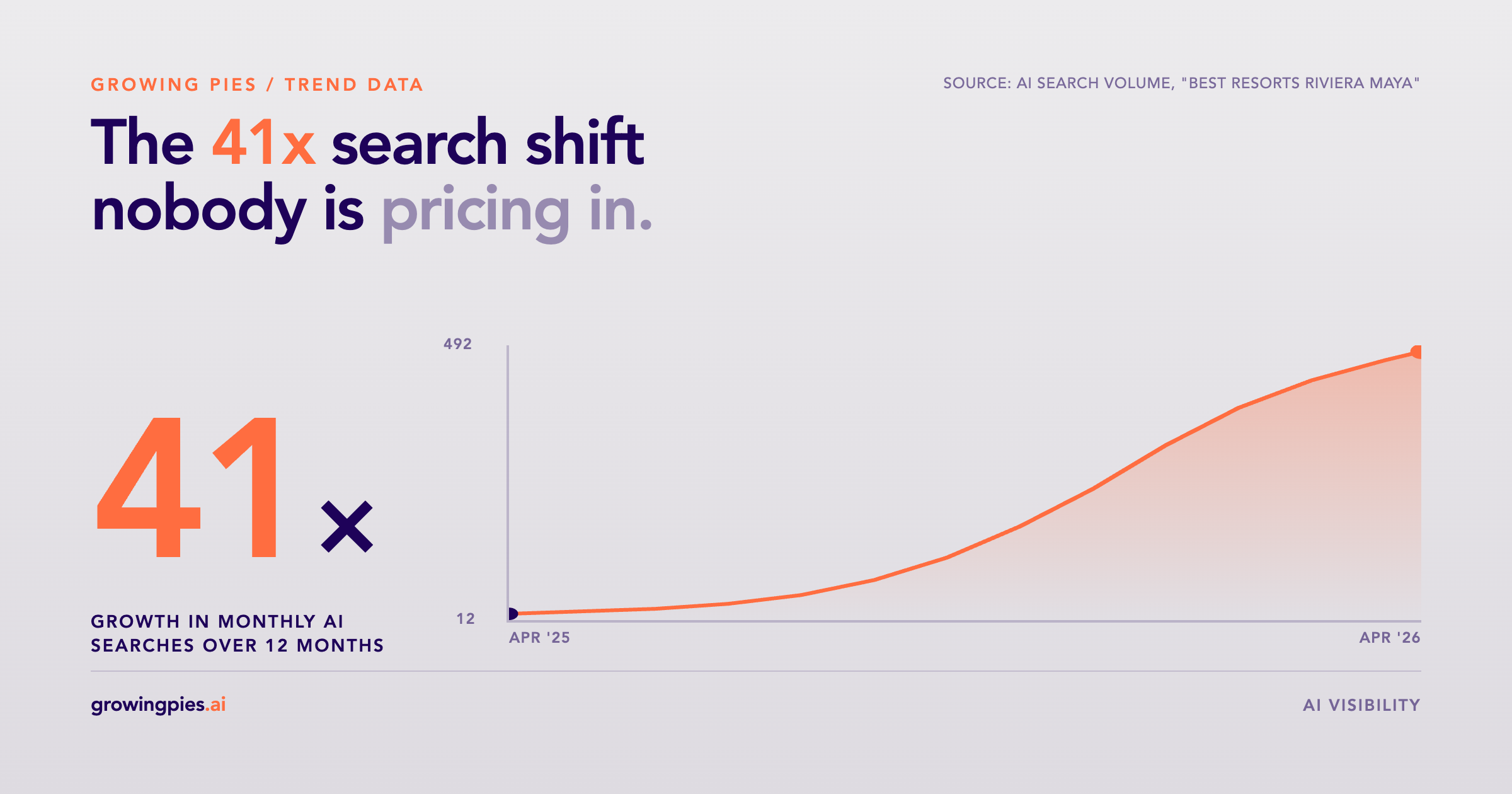
The keyword "best resorts Riviera Maya" went from 12 monthly AI searches to 492 in twelve months. That's a 41x increase. Not 41 percent. 41 times.
And that's just one keyword. The same pattern is showing up across categories — faster in some, slower in others, but the direction is the same and the slope is steeper than anyone is pricing into their planning.
The shift, in numbers
Here's what 12 to 492 actually means in plain English: a year ago, twelve people per month asked an AI assistant a question that should put your luxury resort on a shortlist. Today, almost five hundred people do. By next year — if the trend holds — it'll be the same volume as a mid-tier Google keyword.
And the consideration set is being formed inside the AI answer. Not on a SERP. Not on your homepage. Inside a conversation that takes 8 seconds and produces a list of 3-5 names. If you're on the list, you're in the deal flow. If you're not, you didn't even get the chance to be considered.
This is happening right now. Not in 2027. Not when AI search "matures." Right now, in your category, in the queries your buyers are typing while you're reading this.
Why most companies are missing it
Three reasons we keep running into:
The dashboards don't show it. Google Analytics doesn't break out AI referral traffic cleanly. Your search console doesn't tell you which queries are being answered by AI without you clicking through. Most marketing teams are looking at a dashboard that simply doesn't capture the channel that's growing fastest. So in the data they actually look at, nothing has changed.
The volume is small in absolute terms. 492 monthly searches doesn't sound like much. It's not, in absolute terms. The trick is the slope. 12 to 492 in twelve months means the curve is steep enough that 492 becomes 5,000 inside another twelve. By the time the absolute volume is impossible to ignore, the consideration set has already locked in — and the companies who got cited early are already cited more frequently because of compounding effects.
The fix isn't on anyone's roadmap. Most marketing roadmaps were built around SEO, paid, and content. AI visibility doesn't fit cleanly into any of those buckets. It requires PR-style placement work, technical SEO work, and content strategy work all at once. So nobody owns it, and "we'll get to it next quarter" turns into "we never got to it."
Find out where you stand on AI search
We measure AI visibility for your brand and your top competitors across ChatGPT, Gemini, and Google AI Overviews. Real data. Real prompts. Two-minute order.
GET YOUR AI VISIBILITY ANALYSISThe compounding problem
The reason "we'll get to it next quarter" is dangerous: AI visibility compounds. The companies that get cited today get cited more tomorrow because each citation makes the next citation more likely. Once a competitor has been recommended on a query enough times, AI starts associating them with that query semantically — not just because they're indexed for it, but because the model has learned the pattern.
Unwinding that association is much harder than building it. Once Gemini "knows" that the answer to "best AI tool for product designers" is Competitor X, you can't just publish more content. You have to displace an entrenched signal. That takes years, not quarters.
The window to be the early citation is open right now in most categories. It's not going to be open forever.
The honest version of what to do
I'm not going to pretend there's a magic five-step plan. There isn't. But there's a small, unglamorous list of things that move the line:
- Test what AI says about you today. Pick five buyer-intent prompts in your category. Run them on ChatGPT, Gemini, and Google AI Overviews. See what comes back. This takes 20 minutes and produces a baseline you can measure against.
- Identify which sources AI is citing in your category. The sources are usually the same 10-15 domains. Get on as many of them as you can, in whatever way is defensible — contributor pieces, expert quotes, comparison page outreach, review site claiming.
- Make sure your own site is crawlable by AI bots. If your key pages are JavaScript-rendered, fix that first. We see this kill AI visibility constantly, and it's usually a single development sprint to fix.
None of this is glamorous. None of it will show up in a slide deck as a "transformative initiative." It's just the work. And right now, the work is producing 41x growth on individual keywords for the companies doing it.
The shift is happening. The only question is whether you're inside the consideration set or outside it.