
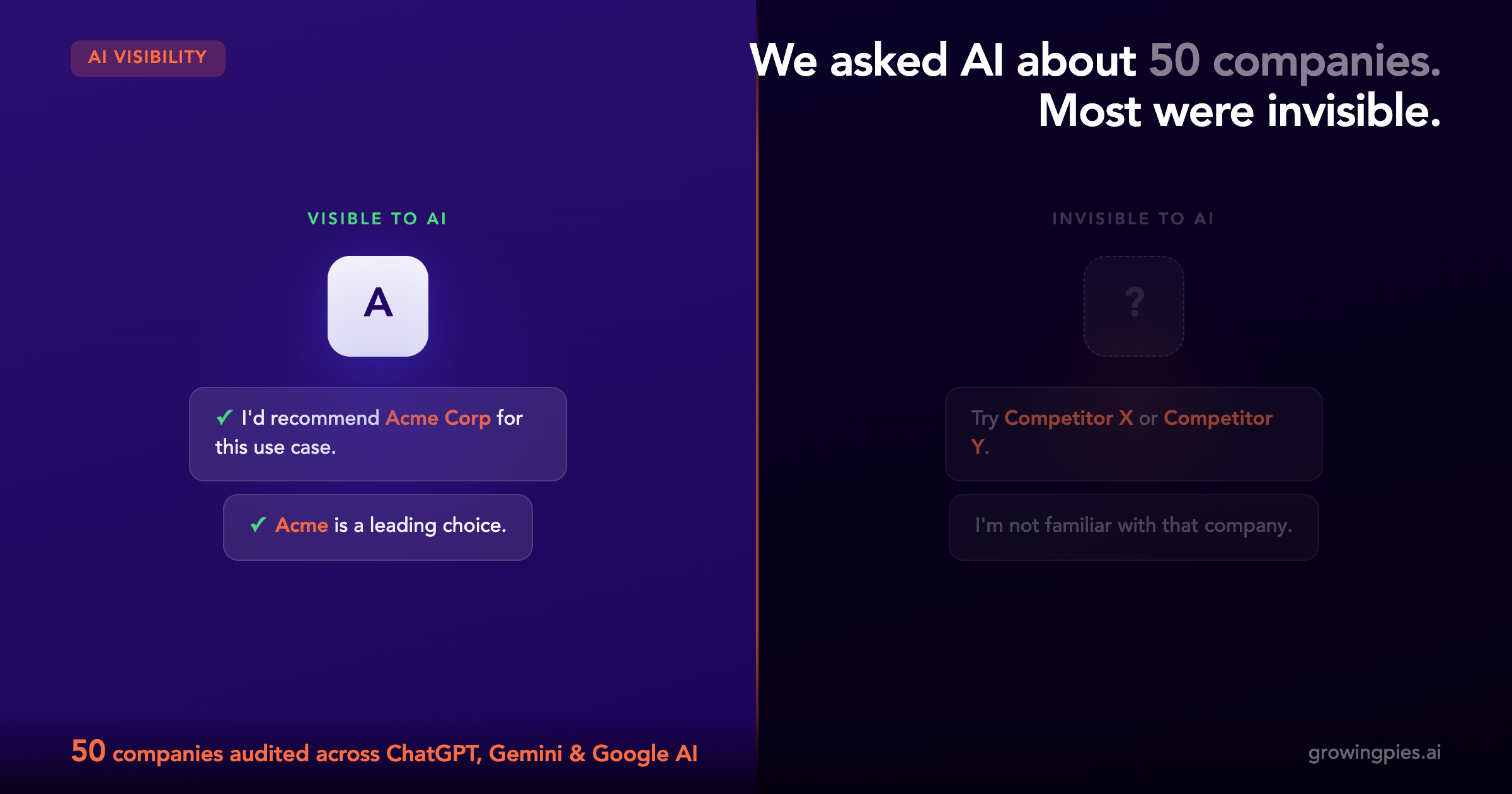
We've audited around 50 companies across SaaS, hospitality, healthcare, and ecommerce for one specific thing: when their buyers ask ChatGPT, Gemini, or Google AI a question about their category, does the company actually show up in the answer?
Most don't. And the ones that do are usually showing up for the wrong reasons.
Here's what we keep finding. There are three patterns. They don't look the same on the dashboard, but they all end the same way — with a competitor closing your deal.
Pattern 1: Truly invisible — 0 mentions, competitors everywhere
A SaaS design tool startup came to us looking pretty healthy on paper. 87 AI mentions across Google AI Overviews and ChatGPT. Decent number.
Then we looked at what those mentions were. Every single one — 100% — was a typography tutorial or a design education blog post published on their own domain. Not one product recommendation. Not one "if you're looking for an AI design tool, try X." Nothing.
So we ran live prompts. The kind of stuff their actual buyers ask: "what's the best AI design tool for product designers?" Here's what came back.
| Platform | Company Mentions | Competitor Tools Named |
|---|---|---|
| Gemini (5 prompts) | 0 | 14 |
| ChatGPT (2 prompts) | 0 | 0 |
| Claude | Not indexed | N/A |
| Perplexity | Not indexed | N/A |
| Total | 0 | 14 |
Zero product mentions. Fourteen competitors named in their place.
AI thinks this company is a blog, not a software product. They've been publishing content since 2023. They have a genuinely differentiated product. None of it matters — because AI learned about them from the wrong content.
That 87-mention number? It's the worst kind of vanity metric. It feels like proof you exist. It's actually proof that AI knows you for things that have nothing to do with what you sell.
How visible is your company to AI search?
Get a detailed analysis of how ChatGPT, Gemini, and Perplexity see your brand. Takes 2 minutes to order.
GET YOUR AI VISIBILITY ANALYSISPattern 2: Known but never recommended — the false health signal
This one is trickier, and honestly more depressing. A luxury resort chain with 30+ properties. AI knows them. AI just won't suggest them.
The numbers look great. 280 AI mentions — 184 in Google AI Overviews, 96 in ChatGPT. Roughly 15.7 million monthly impressions. Ask AI about them by name and 92% of the time you get an accurate, detailed answer ranked in positions 1-3. Any marketing dashboard would call this a win.
Now ask AI the question that actually creates a new customer. "What are the best luxury resorts in Mexico?" "Best honeymoon resort in Riviera Maya?" Out of 5 high-value category keywords, this company shows up in exactly one.
Their main competitor — with one-eighth the property count — shows up in all five.
| Query Type | This Company | Primary Competitor |
|---|---|---|
| Category discovery keywords (5 tested) | Present in 1 of 5 | Present in 5 of 5 |
| Brand queries (position 1–3 rate) | 92% | N/A |
| Genuine recommendation rate | 13% of total, 0% on ChatGPT | Recommended in every category |
And then it gets worse. AI was appending negative qualifiers to every brand answer. Someone asked ChatGPT about one of their own sub-brands — a branded query, a warm prospect already interested — and ChatGPT said "not all-inclusive" and then, in the same response, recommended the competitor by name.
Read that again. AI took a warm lead and handed it to the competition.
The root causes were boring and fixable. A JavaScript-rendered site that AI crawlers can't parse. Review quality that swings wildly between the top-tier and mid-tier properties. Zero presence on the editorial "best of" lists that AI systems quietly treat as ground truth.
But while those sit unfixed: 280 mentions. 15.7 million impressions. And AI is actively redirecting their prospects to a rival.
Pattern 3: Present but outgunned — buried by platform giants
A local healthcare provider, 34 AI citations total. 14 on ChatGPT, 20 on Google AI Overviews. They actually hold position #1 in Google AI for some specific health conditions — which, for a single-location practice, is genuinely impressive.
Then you zoom out.
| Platform | Citations for This Company |
|---|---|
| Google AI Overviews | 20 |
| ChatGPT | 14 |
The category they compete in is owned by content giants. YouTube has 6,819 mentions. Healthline has 3,456. Their 34 citations round to zero next to that.
Where they do show up in source lists, they sit at positions 4-9. Present, sure. Prominent, no. YouTube and Healthline lock up positions 1-3 almost every time.
For a local provider this isn't actually hopeless — the fix isn't to out-publish Healthline. That's unwinnable. The fix is to dominate the narrow, high-intent queries AI already trusts them on. But you can't execute that strategy if you've never looked at the data. And almost nobody has.
Why this matters now
These three patterns — invisible, falsely healthy, outgunned — aren't edge cases. They're the bulk of what we see.
And the common thread is the part that should make you nervous: every one of these companies had decent traditional SEO. They ranked on Google. They had organic traffic. Their dashboards looked fine. AI search just doesn't play by the same rules.
- AI has a reading list. It pulls from a tight hierarchy of sources it trusts — YouTube, Reddit, Wikipedia, G2, editorial "best of" roundups. You're either on the list or you're not in the answer. There's no middle ground.
- Mentions aren't recommendations. Getting cited for a tutorial or FAQ doesn't convert into AI suggesting your product when someone's ready to buy. These are completely different jobs for completely different content.
- Your own domain is fragile. One company we audited had 82.8% of its AI citations coming from its own website. That's not a moat. That's one algorithm update away from zero.
- It compounds. Companies with AI visibility today get cited more tomorrow. The absent ones fall further behind every month. Nobody calls this out, but the gap isn't linear — it widens on its own.
And the shift is accelerating faster than anyone is pricing in. "Best resorts Riviera Maya" went from 12 monthly AI searches to 492 in twelve months. 41x. That's not a future trend — the buying consideration set is moving to AI answers right now, while most companies are still debating whether it matters.
What to actually do about it
Step one is figuring out which pattern is yours. Most companies don't know they have a problem because they've never tested what AI actually says about them. They're guessing — usually optimistically.
That's the entire job our $99 AI Visibility Analysis does. We test your brand across ChatGPT, Gemini, and Google AI Overviews using the prompts your buyers actually use, and we show you:
- How often AI mentions you, and what it says
- Whether those mentions are real recommendations or just informational filler
- Which competitors AI suggests in your place
- The platforms you're visible on — and the ones you're completely missing from
- The specific, fixable reasons your visibility looks the way it does
No fabricated numbers. No generic "do more content" advice. Just what AI is saying about your company right now, and what to fix first.