
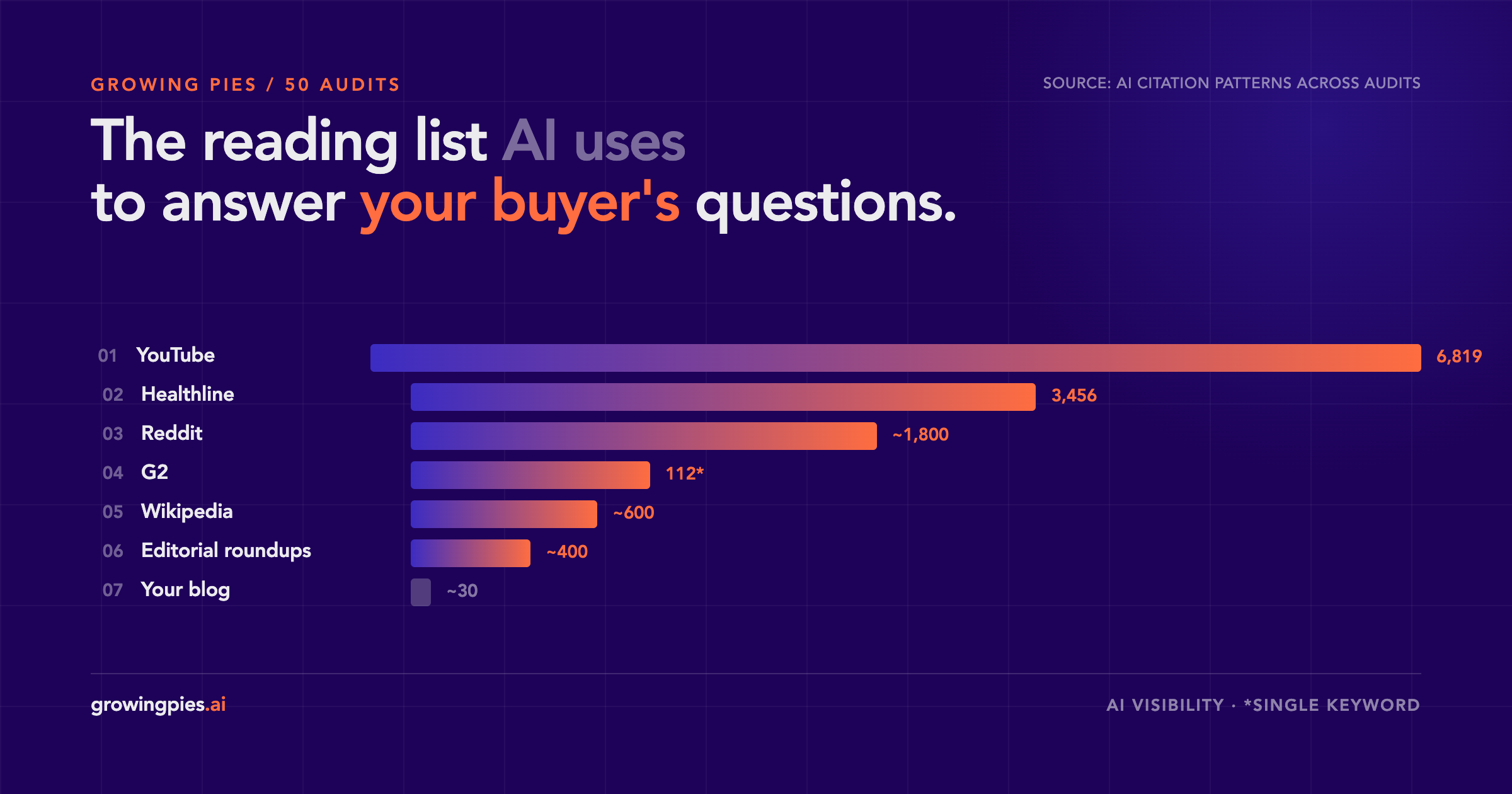
We've now run AI visibility audits on roughly 50 companies. Different industries, different sizes, different stages of growth. We expected the patterns to vary by category. They didn't.
The same handful of domains keep showing up as the source AI cites when answering buyer questions. Across SaaS, ecommerce, hospitality, healthcare, professional services. Same list. Different rankings, but the same ten or fifteen names every time.
That's not a coincidence. AI has a reading list, and once you see the list, the strategy gets a lot less abstract.
The reading list
Here's the rough hierarchy we keep seeing across audits, ordered by how often these domains turn up as cited sources in AI answers:
| Source | What AI uses it for | How hard to get on |
|---|---|---|
| YouTube | How-to, tutorials, demos, comparisons | Medium — depends on channel authority |
| "Best of" recommendations, real-user experience | Hard — mods kill promotional content | |
| Wikipedia | Definitional, neutral, foundational facts | Very hard — notability barrier |
| G2 / Capterra / TrustRadius | SaaS product comparisons | Easy to claim, hard to dominate |
| Editorial "best of" roundups (industry blogs) | Category recommendations | Medium — outreach-driven |
| Healthline / Mayo Clinic (health vertical) | Medical authority | Very hard — institutional |
| NerdWallet / Investopedia (finance vertical) | Financial authority | Very hard — institutional |
| Forbes / Inc / Entrepreneur (business) | Business expertise framing | Medium — contributor model |
| Stack Overflow / GitHub (technical) | Developer authority | Earned through actual work |
| Quora | Long-tail Q&A | Easy to participate, hard to rank |
That's the list. There are exceptions in every category — specialist publications, niche communities, vertical review sites. But these ten consistently dominate. If you're not on any of them, you're effectively invisible to AI for category-level queries.
Real numbers from real audits
To make this concrete: in one design tools audit, G2 alone generated 112 AI citations on a single category keyword. In one healthcare audit, YouTube had 6,819 mentions and Healthline had 3,456 in the client's category — the client had 34. In a luxury hospitality audit, the editorial "best of Mexico resorts" articles dominated AI answers, and the client wasn't in any of them despite being the largest operator in their region.
The pattern across all these is the same: the gap between "well-known company" and "AI-recommended company" is whether you have presence on the reading list, not how big or established the company is.
The content types AI rewards (and the ones it ignores)
AI doesn't reward all content equally. After 50 audits we see four patterns repeat:
Comparison content gets cited heavily. "X vs Y," "best X for Y," "alternatives to Z" — these get pulled into AI answers constantly because they directly answer the comparison questions buyers ask. If your site has zero comparison content, you're missing the format AI most likes to cite.
First-person experience reports get cited heavily. Reddit threads, "I tried X for 30 days" posts, real-user reviews. AI is biased toward content that looks like genuine experience. This is why Reddit punches so far above its weight in AI citations.
Original data gets cited heavily. Surveys, benchmarks, original research, public datasets. If you're the source of a number that other people are quoting, AI will eventually quote you too. This is the highest-leverage content to produce, and almost nobody does it.
Generic thought leadership gets cited almost never. The "5 Ways to Improve Your X" blog post that every B2B company publishes? AI ignores it. There's nothing in there that other sources don't already say better. It's content for ranking on Google in 2018, not for getting cited in 2026.
Find out which sources AI cites in your category
We map the exact domains AI pulls from when answering questions about your industry. That map is your placement strategy.
GET YOUR AI VISIBILITY ANALYSISWhat this means for strategy
If the reading list is fixed and the content types are predictable, the strategy almost writes itself. You don't need to publish more on your own blog. You need to:
- Audit which of the ten sources AI cites in your specific category. Run prompts. List domains. Count frequency. The list will be shorter than the global one. Maybe 5-7 domains for your category.
- Get on those domains in any way that's defensible. Contributed articles, expert quotes, data licensing, review claiming, community participation. None of this is novel digital PR — it's just targeted at the right places now.
- Produce one thing per quarter that's worth quoting. Original data is the highest leverage. A benchmark report. A category survey. Something other people will reference. This is what makes you a source, not just a recipient.
The hard part isn't knowing what to do. It's accepting that publishing more content on your own domain — the thing every B2B company defaults to — isn't the move. It's the move that feels like progress without producing it.
AI has a reading list. You're either on it or you're not. Once you see the list, everything else gets easier.